For sweeping contractors, diversification can be an attractive path to growth. Adding complementary services can open new revenue streams, deepen customer relationships and allow contractors to capture more work from the projects they're already serving.
But building a business capable of delivering all of those services is far more complicated.
Every new service brings additional equipment, employees, training, management and capital requirements. The opportunity can be significant, but taking advantage of it requires the infrastructure to support it.
Dax Winslett knows both sides of that equation.
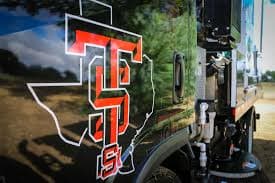
Together with his wife and business partner, Brooke Simmons, Winslett founded San Antonio-based Texas Site Services in January 2020. Today, the company provides street sweeping, pavement markings and thermoplastics, pressure washing, wheel stop and signage installation and other related services throughout Texas.
While the company itself is relatively young, Winslett's experience in the industry dates back more than two decades. He previously owned a sweeping company beginning in 2005 and later served as general manager for another operation before launching Texas Site Services.
That experience not only gave Winslett an established industry network, but also helped shape the multi-service model he and Simmons would ultimately build at Texas Site Services.
"I had already been in the business for years, so we had that network when we started," Winslett says. "Relationships were big for us right out of the gate."
But relationships alone weren't enough to support the growth that followed. As Texas Site Services added customers and took on more work, Winslett and Simmons made another decision that he considers equally important.
"As we scaled up, we scaled our management team, too," he says. "We didn't just scale the sales numbers. We made sure we had the staff who could handle the scale of the work."
When Services Naturally Fit Together
Winslett's decision to build Texas Site Services as a multi-service operation was rooted in lessons he had learned years earlier in the sweeping business.
At his first sweeping company, general contractors regularly asked whether his team could handle striping and other related work. For a while, he turned those requests away. Over time, however, he began to recognize how naturally the services fit together.
"Striping and sweeping really go hand in hand," he says. "You're sweeping from day one of a project all the way through the end."
A newly constructed commercial property may need sweeping before pressure washing, followed by pavement markings, wheel stops, signage or other finishing work. Roadway thermoplastics also frequently require surfaces to be thoroughly cleaned before application.
Those experiences helped inform the broader service model Winslett and Simmons brought to Texas Site Services.
"It becomes this big loop," Winslett says.
The model is particularly well suited to Texas Site Services' customer base. Winslett estimates roughly 90% of its business involves new construction, with projects ranging from Starbucks locations and schools to Amazon facilities, parking garages and city streets.
For sweeping companies considering a similar strategy, however, complementary services don't necessarily mean easy expansion. Striping, pressure washing and thermoplastics each bring different equipment, expertise, training and operational requirements.
Diversification can create new revenue opportunities, but it also requires a business capable of supporting them.
Becoming a Partner, Not an Invoice
As Texas Site Services has grown, Winslett and Simmons have remained committed to something decidedly low-tech: meeting customers face-to-face.
"People want to deal with people," he says. "They want the handshake. They want to see you eye to eye."
The team visits customers' preconstruction and estimating departments and holds meet-and-greets with the people it will be working with.
"We want our customers to know who they're doing business with," Winslett says. "We're not here to be an invoice. We want to be a business partner."
Part of that partnership is sharing expertise. Winslett is seeing a younger generation move quickly into positions of responsibility, often without years of field experience in specialized areas. He believes experienced professionals have an important role to play in helping educate them.
That willingness to share knowledge also strengthens the relationships Winslett considers central to the business.
"You can't put a price tag on trust," he says.
Building Infrastructure Behind the Growth
In Texas, there is no shortage of opportunity.
"Construction here is insane," Winslett says. "Sometimes it's hard to see outside our bubble, but we're blessed to have the growth we're seeing in this state."
The challenge for Texas Site Services isn't necessarily finding work. Its estimating team recently processed approximately $2 million in striping estimates alone.
Instead, one of its biggest constraints has become something far more tangible: space.
The company has outgrown its current facility and is looking for property where it can eventually build a larger headquarters.
"Right now we're busting at the seams," Winslett says. "It's hard to keep buying equipment when you don't have enough space to park it."
Technology is also helping the company manage the complexity of a growing operation. Texas Site Services uses OneCrew to consolidate processes that previously required Excel and multiple systems, while Samsara provides GPS fleet tracking and greater visibility into vehicles and equipment.
Winslett says the company continually evaluates available technology with a straightforward goal: finding solutions that support the way its multi-service operation actually works.
Growing People Alongside the Business
For Winslett and Simmons, the most important infrastructure remains their people.
Simmons brought a background in psychology and educational leadership to Texas Site Services, experience that has helped shape the company's approach to culture, training and employee development.
The company's management team has also participated in Echelon Front training based on principles of extreme ownership, an approach that encourages employees to own mistakes, identify solutions and use challenges as learning opportunities.
"The bottom line is people," Winslett says. "When someone comes in for an interview, we tell them, 'We're here to make you successful.' We want to invest in people. Our people aren't just a number."
That philosophy has helped Texas Site Services maintain low turnover while developing employees who can take on greater responsibility as the company expands.
Looking ahead, Winslett sees plenty of room for growth in sweeping and related services. The more important question for contractors, he says, is: "How much can you handle?"
For those looking to expand beyond traditional sweeping, his first advice is to have the management infrastructure in place.
"Have your management team ready," he says. "Have people lined up that you can trust to handle everything from contracts to submittals to the project itself."
Hear Dax Winslett at Sweeper Summit 2026.
Join contractors from across the country at Sweeper Summit & Outdoor Equipment Expo in San Antonio, November 3–4.
Register NowCash flow is equally critical. New services require upfront investment, and adding them without sufficient management can magnify financial pressure.
Contractors also need to be willing to invest both time and money in training.
"You can't do it with the same amount of people," Winslett says. "You have to be willing to sacrifice the time and money to train people."