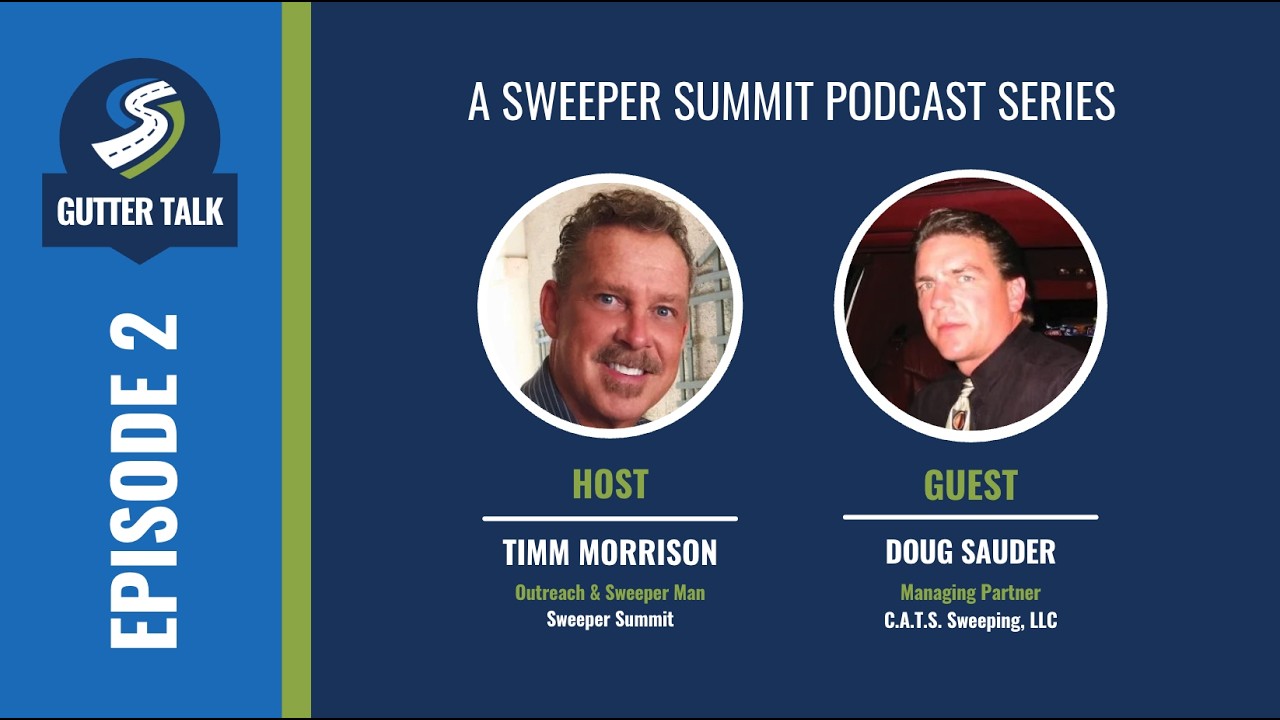
In this Sweeper Summit 2026 episode of Gutter Talk, host Timm Morrison ("Sweeper Man") sits down with Doug Sauder of C.A.T.S. Sweeping to unpack 35+ years in the street sweeping business — choosing a niche, growing parking lot sweeping accounts, the real value of the 1-800-Sweeper network, and the one piece of advice that changed how he runs his company.
You've probably heard somebody tell you to "get your mind out of the gutter." On Gutter Talk, Timm Morrison wants to do the exact opposite. "We want your mind in the gutter," he says at the top of this episode — and for the next 19 minutes, that's where it stays, as he sits down with a guy who's been living in the proverbial gutter, in the best way, for more than three decades.
Doug Sauder graduated from Villanova in 1988 — a Wildcat — and launched into the street sweeping business the same year. Thirty-five-plus years later, he runs C.A.T.S. Sweeping out of New Jersey's Delaware Valley and has watched the trade transform from both ends: the technology in the trucks (which Doug notes has changed dramatically even in just the past few years) and the business itself. Here's what came out of the conversation — and why it's a preview of the kind of knowledge-sharing that defines Sweeper Summit 2026.
Pick a Niche in the Sweeping Industry — Then Own It
One of the first things Doug stresses is that the sweeper business isn't one business. It's several, and you have to decide which avenue you want to be in.
C.A.T.S. went after the heavier-duty work: dirt, road maintenance, and road reconstruction. The "dirt piece" was driven by new housing construction — soil erosion control rules require builders to sweep the streets under construction at each phase, whether that's once, twice, or three times a week. From there the company expanded into milling and paving operations, following the mill and prepping for paves.
They also dabbled in special events like concerts — though Doug laughs that it may not have been his wisest move, given "the crazy people at 2 in the morning who were still hanging out."
Municipal work? They touched it here and there, but Doug largely passed on it. His reasoning is a window into how he thinks about the business: "That work was bid work… there's some crazy numbers that come out and I really wasn't interested in spending my time on something that I wasn't going to get anyway."
So early on, C.A.T.S. made a deliberate choice: they don't bid. "Here's our rates. We're good at what we do — and we still operate that way today."
How to Grow a Parking Lot Sweeping Business
Doug is candid that the parking-lot sweeping side didn't perform the way he wanted at first. The thing that got him "over the hump" wasn't the sweeping at all. It was expanding the services he offered property owners.
The turning point was an acquisition in 2016. The deal came with 53 shopping centers — and in the first month, Doug "fired" enough customers to get down to about 37. Why? Because the company he bought from had contracts that had expired back in 1994, and the previous owner was still charging 1994 rates.
"One customer I called and I said, 'Hey, we're the new owners and your price is now X per sweep.' And they said, 'Well, you're tripling it.' I said, 'Buddy, you've been getting a great deal for a long time.' And we lost it. And I was fine with it."
But the real growth came from what C.A.T.S. layered on top of the sweep. The obvious add-ons first — power washing, cleaning out stores, storm cleanup. Then it evolved into something more valuable: becoming the eyes of the center.
That mattered most for absentee owners and property managers — the manager sitting in Georgia, upstate New York, or California who owns a shopping center two time zones away. In one case, a client bought a center and knew nothing about its rooftop HVAC unit. So Doug went up on the roof, took pictures, and assessed in his own way whether it was usable.
That one favor turned into a system: a tick-mark legend of what's good and bad at each center. Faded stop signs, bent or missing stop signs, broken curbs, fading striping — all of it captured in periodic reports. "We should use this for everybody," Doug realized, and they did.
The smart operational move underneath all of this: instead of trying to do everything in-house, C.A.T.S. started subbing work out and managing the process instead. Some owners say, "That's what I have property managers for." But plenty of property managers are stretched so thin they can't keep their eye on the ball — and that's exactly the gap C.A.T.S. fills.
Yes, the Pothole Repair Video Was Real
Morrison had to ask about a video he'd seen online: were you guys actually filling potholes, or was that AI?
It was real. The product was a cold patch — no heat strictly required, though Doug's crews would use blow torches to warm it up. It came about because a sweeping customer of his got into the cold-patch business and asked him to shoot a little commercial for them, probably back around 2013.
Morrison, speaking from a rough Midwest winter where "it looks like a war zone," summed up the sentiment a lot of people feel: "When I see people out filling in potholes, I just want to go hug them."
Sustainability in Street Sweeping: The Brushes, the Cows, and the Recycling Center That Said No
For years C.A.T.S. used a one-piece "tube broom." When the brushes wore out, they were hard to dispose of — so Doug found local farmers who'd take them. (Morrison guessed a llama farm; Doug set the record straight: it was cows and pigs, who used the worn brushes as back scratchers.)
Then the farms disappeared. With all the housing development in New Jersey, Doug says there isn't one big farm left in his area. So C.A.T.S. switched to "strip brooms," which are a lot easier to dispose of.
And then comes the punchline. Everybody's big on recycling, right? Doug has a plastics recycling center five minutes away. He brought one strip over and showed the plant manager: "I said, 'I have these and I want to bring them over for recycling.' He said, 'We can't take that.' I said, 'I don't understand — it's plastic.' He goes, 'We just can't take that.' I said, 'So you want me to throw it in the dumpster?' 'Yes.' And I said, 'That's going to the landfill.' 'Yes.' Okay. So I tried."
Sometimes you do the right thing and the system isn't ready for you yet.
Why the 1-800-Sweeper Network Matters for Growing Sweeping Companies
Late in the episode, Morrison turns to the 1-800-Sweeper members watching — welcoming new companies like Elite Sweeping in Baton Rouge, First Facility in Oklahoma City, and United Sweeping in Jackson, Mississippi — and asks Doug for advice for owners taking their first baby steps toward growth.
Doug has been a 1-800-Sweeper member since 2011, one of the originals, and has attended the Sweeper Summits since they began around 2012. Back then he was the young guy, tapping the ears of the older operators: How did you do this? How did you do that? Some advice he ran with; some he adapted to fit his own business.
"The summit provides the opportunity for everybody, regardless of your experience level, to potentially walk away with something you never thought of. Sometimes I've walked away thinking, 'Wow, I can't believe that simple thing I never thought of — and what a big impact it ended up having.'"
He loves the leads. He loves the discounts on purchases. But for Doug, the real value is the information you get from others. And he admits, with a laugh, that somewhere along the way he became the old guy in the room.
His number-one recommendation to the next generation is exactly what worked for him: ask questions. There's plenty of downtime and free time at the summit, everybody's great, and everybody loves to share.
Morrison shares a celebrated example of that synergy in action. One member — a good friend of Doug's, from Boston — hit obstacles he couldn't overcome and came to the summit hoping for an answer. It didn't happen. Three days later, having essentially resolved to sell the company, he was at a bar. A couple of guys asked how he was doing. "Not good," he said. One of them put an arm around him: "Let me help you. Let's figure this out."
That conversation got him a lead. That lead led to five, which led to five more, and five more. A short time later, that same member is in line to be named NAPSA president.
As Doug puts it: what's really cool now is that 1-800-Sweeper has experience. It's been around since 2011, with plenty of people in it for the long haul. That first Sweeper Summit, by contrast, was "kind of like just throwing crap on the wall and seeing what happens" — held in a carpeted CE-bin with round tables, and crockpots of food in a parking lot in Memphis.
It clearly stuck. This year, Sweeper Summit 2026 heads to La Cantera Resort & Spa in San Antonio — a long way from the crockpots.
The One Piece of Advice That Moved the Needle
Morrison closes every Gutter Talk the same way: he asks his guest for the single piece of advice that was so profound it changed the trajectory of their business or life.
Doug went the business route. Around 2005 or 2006, his financial advisor told him something he resisted at the time: "You've got to stop letting the customers run your business… you're killing yourself and you're going to burn yourself out. You've got to coach the customers on how things operate in your business. It doesn't mean you tell them no — but you direct them in a direction that befits how you run your business."
Doug didn't act on it right away. In fact, he didn't really do it until about ten years later — and he wishes he'd done it sooner.
"The customers don't even realize that I coached them to how I want to do things. They didn't even know I did it. And now it's a process. And I love processes. Processes are good."
That's the note the episode ends on, and it's a good one for any operator: stop being run by your customers, and start coaching them — gently, deliberately — into the way your business actually works best.
Join Us at Sweeper Summit 2026 in San Antonio
The kind of knowledge-sharing in this episode — pricing strategy, service expansion, sustainability, and the relationships that turn a struggling operator into an industry leader — is exactly what Sweeper Summit 2026 is built around.
Catch Doug Sauder and the rest of the crew at La Cantera Resort & Spa in San Antonio, November 3–4. As Timm signs off: keep cleaning, keep moving, and keep business top of mind. New episodes of Gutter Talk drop monthly — subscribe wherever you listen.
Join Doug Sauder and the industry at Sweeper Summit 2026.
Secure your spot at the 15th annual Sweeper Summit in San Antonio, November 3–4, and experience the networking, education, and camaraderie Doug describes in Gutter Talk Episode 2.
Register NowWatch the full conversation above to hear Doug Sauder's story in his own words — from picking a niche and growing parking lot accounts to the 1-800-Sweeper relationships that shaped his career.